 Dried squid
 Flattened dried squid
 Seasoned Shredded Squid
 Dried squid snack

 Tiếng Việt
 ไทย
Dried squid is a dish chosen by many families to savor, give as gifts, or process into many delicious dishes. However, on the market, there are still dried squid products of unknown origin, poor quality, or counterfeits, making it difficult for buyers to distinguish with the naked eye. Therefore, how to identify fake dried squid is an issue consumers should learn about before choosing to buy, especially when the product has an unusually cheap price or unclear origin information. Let’s find out with Ola Squid in this article!
What ingredients is fake dried squid made from?
When talking about what fake squid is made of, many people immediately think of rubber or plastic. In fact, fake products or products shaped like squid can use many different types of raw materials depending on the production method. Some materials mentioned include: starch, cellulose, rubber, or synthetic polymers, combined with flavorings and food colorings to create a shape, color, or smell similar to squid.
These materials do not have the natural muscle structure and squid fibers. Therefore, when observing or tearing them, the product may show different signs compared to real dried squid.

However, you should not rely on just one sign to conclude that it is fake squid. Some types of real squid have different sizes, colors, and chewiness depending on the species, preparation method, as well as the sun-drying or dehydrating method. The most accurate way to identify is still to check multiple characteristics simultaneously and prioritize products with transparent origins.
How to identify fake dried squid quickly
To identify fake dried squid, you can check the product according to the steps below. Each sign is for reference only, but if a product exhibits multiple abnormal characteristics at the same time, you should consider carefully before buying or using it.
Observe the external shape and color
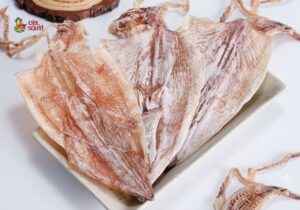
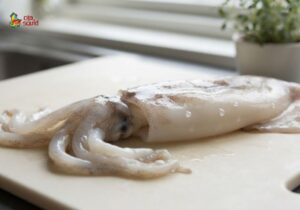
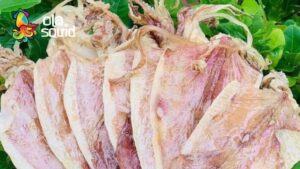
Real dried squid retains the relatively natural shape of the squid after cleaning, sun-drying, or dehydrating. The body, head, tentacles, and tail of the squid remain intact, attaching relatively firmly to each other. On the body, there are natural veins or muscle fibers, not too smooth and uniform.
When checking, you can pay attention to the following signs:
- Squid tentacles: The tentacles have a natural curve and shape, not too uniform or unusually stiff.
- Head and body parts: The two parts have a balanced proportion, without feeling unnaturally pieced together.
- Tail and joint parts: Be careful with products that show signs of the tail, head, or tentacles being unnaturally attached or glued.
- Mid-body cartilage: Whole dried squid has natural muscle structure and cartilage lines; products with too flat, uniform surfaces may need to be checked more closely.
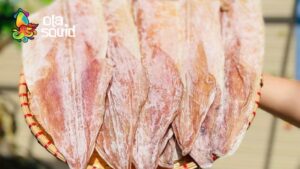
- Color: Real dried squid has an off-white color on the body, which can be mixed with natural pink, red, or brown on the outside depending on the type. If the color is too uniform, too eye-catching, or shows signs of dyeing, you should be cautious.
See more: Is white powder on dried squid normal? Is it edible?
However, color is not an absolute criterion to distinguish fake dried squid. Squid sun-dried or dehydrated using different methods may have different dark or light colors.

Smell, test with fire
Real dried squid has a characteristic aroma of seafood after being sun-dried or dehydrated, not a strong fragrance like artificial flavorings. When smelling, you should pay attention if the product has a chemical smell, plastic smell, or an unusually strange aroma.
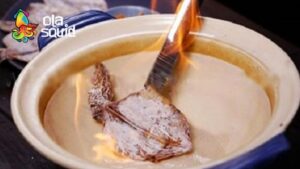
Some folk tips also use fire to check for rubber fake squid or products suspected of being made from synthetic materials. Real squid usually shrinks, burns, and emits a characteristic smell when exposed to heat; while some synthetic materials can burn quickly, shrink abnormally, or create a burnt plastic-like smell.
However, you should not view burning squid as an accurate method to determine whether it is real or fake. Burning food directly can generate smoke and decomposition products that are not good for health. If the squid has abnormal signs right from observing, smelling, or tearing, it is best not to continue testing by burning.

Check elasticity when tearing
Real dried squid is composed of muscle fibers, so when torn, the meat fibers can be seen relatively clearly. Depending on the type of squid and the dryness level, the chewiness may vary but does not create a uniform feeling like a piece of rubber.
Conversely, products suspected of being rubber fake squid may have too strong elasticity, being difficult to tear or stretch like rubber materials. When torn, the inside may be flat, smooth, and uniform instead of separating into muscle fibers.
You can check according to the steps:
- Gently bend with your hand to feel the hardness and elasticity.
- Tear a small part at the edge of the squid body.
- Observe the inside to see if there are natural muscle fibers.
- Pay attention if the product stretches abnormally, is overly elastic, or has a rubber-like texture.
However, real squid processed and dried at different levels also has different chewiness. Therefore, you should not rely solely on the chewy sensation to conclude that the product is fake squid.

Soak in water to check the powder layer
Some products suspected of being fake squid may be shaped or coated on the outside to mimic the color and texture of dried squid. Therefore, soaking a small part in water can help you observe more abnormal signs.
When soaking, please pay attention to observe:
- Whether the surface peels off or disintegrates into abnormal layers.
- Whether the water shows strange color or smell.
- Whether the inside reveals materials different from the muscle structure.
- Whether the product becomes too slippery, elastic, or rubber-like after soaking.
If the outer layer disintegrates but the inside reveals a uniform, chewy material like rubber or plastic, you should stop using the product.
See more: Summary of 9 ways to soak dried squid to make it soft while maintaining its delicious chewiness
However, soaking in water to check the powder layer is also a preliminary test method. Real dried squid when soaked in water will also absorb water, soften, and change color, so the change after soaking does not mean the product is fake.

Check the packaging and labels on the product
Packaging is one of the important factors when choosing dried squid. Instead of just looking at the appearance of the squid, you should check the product information and the responsible entity.
A reputable dried squid product will have clear information about its origin and the product itself. You can check:
- Product name and information about the type of squid.
- Production date and expiration date.
- Name and information of the production and business facility.
- Storage instructions.
- Traceability information or product code if available.
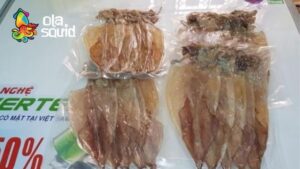
- Condition of packaging, labels, and packaging method.
Barcodes can help you check more information about the product, but scanning the barcode alone is not enough to know if the product is genuine. When checking, you should also compare the product name, manufacturer, origin, information on the packaging, and other identification signs.
Compare selling prices
Good quality dried squid raw materials have prices depending on the type of squid, size, source of raw materials, dryness, processing and production process. If a product is advertised as high-quality dried squid but has a significantly lower price than the general market without a clear reason, you should check its origin carefully before buying.
However, low price does not necessarily mean fake squid. Sellers may be running promotions, selling small-sized squid, or products with different qualities and classifications. Therefore, you should combine the price factor with the shape, texture, packaging, and origin of the product.
See more: How to choose delicious dried squid, avoiding buying fake goods by mistake
Harmful effects of eating fake squid or chemical-soaked squid
Eating fake dried squid or squid processed with substances unsuitable for food can pose many health risks. The level of impact depends on the type of ingredients, chemicals used, concentration, and the amount of product consumed. Some risks consumers need to be aware of include:
- Causing digestive disorders
- Increasing the risk of exposure to unsafe chemicals
- Affecting health if consumed regularly
- Difficulty in controlling nutritional value
- Young children, the elderly, or people with sensitive digestive systems may easily experience adverse reactions when using food of substandard quality
See more: What does squid clash with? Foods to avoid combining with squid
Therefore, if the squid has a chemical smell, unusual color, rubber-like texture, peeled outer layer, or lacks clear origin information, you should not continue to taste-test it.

How to buy dried squid to limit the risk of fake goods
Instead of only finding out how to identify fake dried squid after buying, you should actively select products from the beginning. Clear origin and transparent product information remain more important factors than visual inspection tips.
When choosing to buy dried squid, you should:
- Choose a reputable seller: Prioritize brands or establishments with clear information, specific addresses, and contact channels.
- Ask clearly about the origin: For whole dried squid, you should find out about the type of squid, raw material sourcing area, and processing method if the seller provides information.
- Observe the product before receiving: Do not buy if the squid has a strange smell, too unusual color, or unnatural shape.
- Check the packaging: Packaged products need to have the necessary information so that buyers can identify and store them properly.
- Do not go for too cheap prices: Compare prices with similar products in terms of squid type, size, and quality.
- Prioritize brands specializing in squid: Entities focusing on dried squid products have advantages in raw material sources, processing procedures, and the ability to provide product information.
If you are looking for a place to buy dried squid with clear product information, you can refer to the dried squid products provided by Ola Squid. The brand focuses on dried squid, helping buyers easily learn about and choose suitable products instead of having to search among too many different types of food.

Further reference:
Frequently asked questions about fake dried squid
Is fake squid edible?
You should not eat fake squid or products suspected to be fake squid. If the raw materials and production process cannot be identified, you cannot know whether the product contains materials unsuitable for food, additives, or unauthorized chemicals.
Does fake dried squid have a fishy squid smell?
Some counterfeit or simulated squid products may have flavorings added to create a smell close to real food. Therefore, a fishy smell or squid-like aroma is not enough to confirm that the product is real squid.
Where to buy clean dried squid with clear origin for peace of mind?
When buying dried squid, you should prioritize brands specializing in squid products, with clear information about the product, origin, and storage instructions. This helps reduce the risk of buying products of unknown origin or substandard quality.
Ola Squid is a brand focusing on dried squid, suitable for consumers looking for dried squid products instead of a store selling many different food groups. You can refer to the information and dried squid products on the website of Ola Squid before making a choice.
Knowing how to identify fake dried squid helps you be more proactive in choosing food and reduces the risk of buying products of unknown origin. However, test methods such as soaking in water, tearing, or burning squid are for reference only and cannot accurately determine whether the squid is real or fake.
To buy delicious and high-quality dried squid, you should prioritize products with clear origins, complete product information, and sold by reputable addresses. When buying, observe carefully both the appearance, smell, and texture of the squid instead of relying on a single sign alone.